
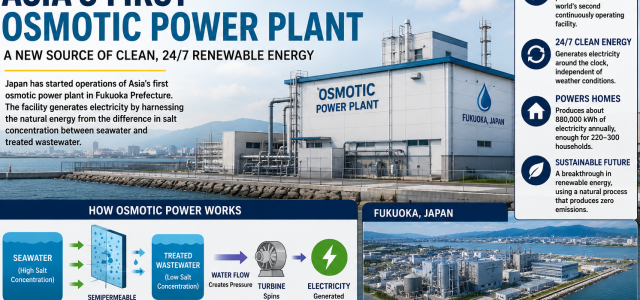
Japan has officially launched Asia’s first osmotic power plant, a breakthrough renewable energy project that generates electricity using the natural difference in salt concentration between seawater and treated wastewater.
Located in Fukuoka Prefecture, the facility began operations in August 2025 and is considered only the second continuously operating osmotic power plant in the world. The project represents a significant step toward developing clean energy sources that can generate electricity around the clock without relying on sunlight or wind.
The technology works by harnessing the process of osmosis. When freshwater and saltwater are separated by a special membrane, water naturally moves across the membrane, creating pressure that can be used to drive turbines and generate electricity.
According to project developers, the plant is expected to generate approximately 880,000 kilowatt-hours of electricity annually—enough to power around 220 to 300 households. Unlike solar and wind energy, osmotic power can operate continuously regardless of weather conditions.
Experts believe the success of the Fukuoka facility could encourage other coastal regions around the world to explore osmotic energy as part of their clean energy strategies. However, challenges related to efficiency and large-scale deployment still remain.