
Introduction
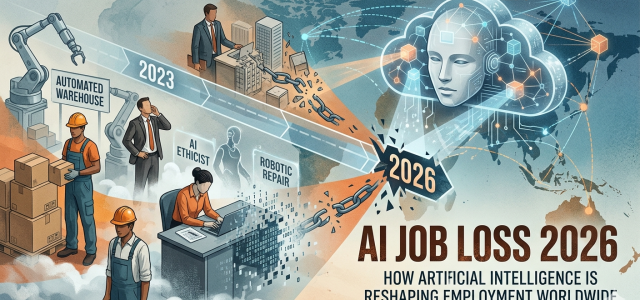
The topic of AI job loss in 2026 has become one of the most discussed issues in the global labor market. As artificial intelligence continues to evolve rapidly, companies across technology, finance, customer service, and other sectors are restructuring their workforce.
In 2026, reports and industry data show a growing trend where AI is not only automating repetitive tasks but also changing how entire job roles are designed. While some industries are creating new AI-related positions, others are reducing traditional roles due to efficiency gains from automation.
How AI Is Driving Job Changes in 2026
Increasing automation across industries
Artificial intelligence systems are now capable of handling tasks such as data processing, customer support, basic coding, and administrative work. This has led many companies to reduce reliance on human workers for repetitive functions.
Recent industry reports suggest that thousands of tech jobs have been affected in early 2026, with a significant portion linked to automation and restructuring efforts driven by AI adoption .
At the same time, experts note that not all job losses are directly caused by AI. In many cases, companies also cite cost-cutting, economic pressure, and organizational restructuring as key factors behind layoffs
Tech industry and corporate layoffs
The technology sector has been one of the most impacted areas. Several large companies have reduced staff while increasing investment in AI systems and infrastructure.
Some reports indicate that AI-related transformation is accelerating structural changes in the job market, especially in roles involving routine digital tasks and entry-level office work .
Which jobs are most affected by AI?
High-risk job categories
- Data entry and clerical roles
- Customer support and call center jobs
- Basic administrative positions
- Routine content production tasks
- Some entry-level IT and coding roles
These roles are more vulnerable because they rely heavily on repetitive digital processes that AI can now perform efficiently.
Emerging opportunities
At the same time, new roles are being created, including:
- AI system trainers and supervisors
- Machine learning engineers
- Data analysts
- AI ethics and governance specialists
- Automation workflow designers
Is AI replacing jobs or transforming them?
Experts are divided on whether AI is eliminating jobs or reshaping them. Some research shows that AI is often used to augment human work rather than fully replace it, especially in skilled professions.
However, there is also evidence that certain companies are using AI to significantly reduce workforce size, particularly in departments where automation can replace manual tasks.
This means the impact of AI is not uniform—it depends on industry, job type, and how quickly companies adopt automation technologies.
Global impact of AI job displacement
Studies suggest that millions of jobs worldwide are already being affected by AI-driven systems, either through automation or restructuring. However, the long-term outcome may include both job losses and new job creation as economies adapt to AI integration .
Key Points Summary
- AI is reshaping global employment in 2026
- Automation is reducing demand for repetitive jobs
- Tech and office-based roles are most affected
- New AI-related careers are growing rapidly
- Not all layoffs are solely caused by AI
- The labor market is shifting, not disappearing
Conclusion
The rise of AI job loss in 2026 reflects a major transformation in how work is organized globally. While artificial intelligence is improving productivity and efficiency, it is also forcing industries to rethink traditional job structures.
The future of work will likely depend on how quickly workers and organizations adapt to this shift—especially by developing skills aligned with AI-driven systems rather than competing against them.